AI lip sync for singing: how a photo sings a song in sync
myumi Team · Published November 16, 2026 · 6 min read
How AI lip sync works for singing, why it’s harder than speech, which photos and songs work best, and how to label the video. Samples in five languages.
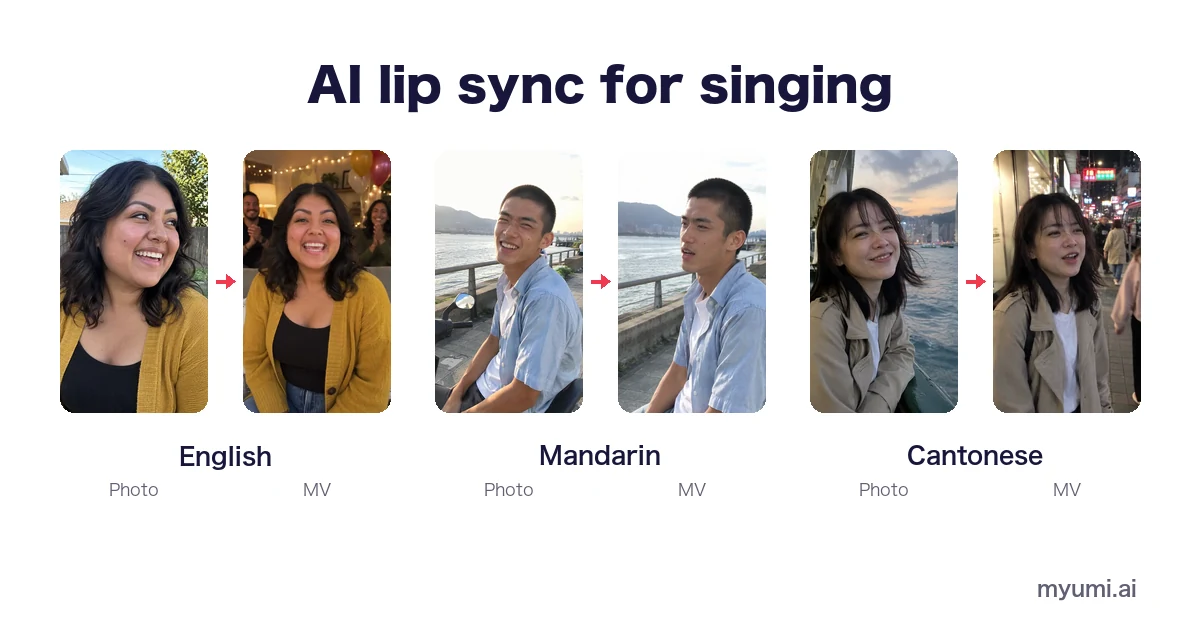
An AI lip sync music video takes one photo and a song and moves the person’s mouth to the sung words, so the person in the photo looks like they’re singing. Singing is harder to sync than speech: held notes, fast lines and backing vocals all get in the way. The best results come from a clear photo, a clean lead vocal and one singer.
This guide explains how AI lip sync for singing differs from a talking photo, why singing is harder, which photos and songs work best, and what to do before you post.
What is an AI lip sync music video?
Three things often get called “lip sync”, and they’re not the same:
| Talking photo | Lip sync trend (TikTok) | AI lip sync music video | |
|---|---|---|---|
| What goes in | A photo + speech or text | You, filming yourself | A photo + a song |
| Who moves | The face in the photo | You, mouthing the words | The person in the photo, singing |
| What you get | A short clip of someone talking | A clip of you miming a song | A video where the person sings the song |
| Hard part | Natural expression | Your timing | Following the melody, not just the words |
This article is about the last one: the person in a photo singing a song, with lips that follow the lyrics. In myumi, that singing happens inside a music video scene set by a template, such as a karaoke room or a beach at sunset.
Why singing is harder to lip sync than speech
When we talk, each sound is short and the mouth keeps moving. Singing stretches and bends the same sounds:
- Held notes. One vowel can last two seconds. The mouth has to stay open in the right shape instead of chattering.
- Fast lines. Rap verses and quick choruses pack many syllables into a beat.
- Breaths and pauses. The mouth should stop moving in the rests.
- More than one voice. Harmonies, backing vocals and duets give two or more mouths’ worth of sound to one face.
- Effects. Heavy reverb or vocal effects blur the words.
Language matters too. Cantonese, for example, has words that end with the lips closed, like 十 (sap) and 心 (sam); in Mandarin (shí, xīn) the lips stay open. A mouth shaped for Mandarin can look wrong to Cantonese speakers. myumi names the five languages it sings: English, Japanese, Mandarin, Cantonese and Taiwanese Hokkien.
Which photos work best
- One person, mouth visible: facing the camera or turned slightly, with nothing in front of the mouth.
- A photo of yourself, or of someone who has agreed. Minors need a parent’s or guardian’s consent, and photos of celebrities aren’t allowed.
The full checklist is in How to turn a photo into a music video.
Which songs work best
- A clear lead vocal. One singer, sitting on top of the mix.
- The section you want. For TikTok, Reels or Shorts, the chorus usually works better than the intro.
- A song you can use. Your own song, one you have permission to use, or one myumi prepares. Commercial recordings and karaoke tracks need permission from their rights holders. Made it with Suno? Read How to make a music video for your Suno song for its 2026 rules.
Hear it in five languages
Each of these samples is a person in a photo singing, with lips following the lyrics:
- English: Birthday Party, Karaoke Star
- Japanese: City Pop Night Drive (page in Japanese)
- Mandarin: Mandarin song MV
- Cantonese: Cantonese song MV
- Taiwanese Hokkien: Taiwanese Hokkien song MV
Every sample person and song is AI-generated.
How to make one with myumi
- Pick an MV template. It sets the scene and the camera.
- Add one photo. The person in it becomes the singer.
- Upload your song, or let myumi prepare one. The mouth follows each sung line.
myumi is on a waitlist for now; pricing comes at launch.
Before you post: label it
YouTube requires creators to disclose realistic AI-generated or altered content, including content that makes a real person appear to say or do something they didn’t do (YouTube Help). TikTok asks for a label on AI-generated content that shows realistic people (TikTok Community Guidelines). A realistic singing photo will normally need it, so turn the label on.
FAQ
Can AI lip sync a song in any language?
Some tools promise “any language”. myumi names the five it sings: English, Japanese, Mandarin, Cantonese and Taiwanese Hokkien, with a sample for each.
Does it use my voice?
It uses the vocals in the song you upload. myumi doesn’t change or copy voices.
What’s the difference between a talking photo and a singing photo?
A talking photo speaks a line of speech or text. A singing photo follows a melody: held notes, rests and fast lines, which is harder.
Is AI lip sync accurate for rap?
Fast lines are among the hardest parts of any lip sync, because so many syllables fit into each beat. Use a clean vocal without stacked ad-libs for the best result.
Can I use a photo of someone else?
Only with their agreement. Minors need a parent’s or guardian’s consent, and photos of celebrities aren’t allowed.
What’s the best AI lip sync for singing?
Look for named languages with a sample in each, mouths that hold long notes and stop in the rests, and results that stay clean with one lead singer. Compare tools side by side on Photo-singing apps compared.
Is it free?
myumi will announce pricing at launch. For what other tools charge, see Photo-singing apps compared.